
Latvian
Recorded in Riga and Baltic centres, 1900s–1930s
The collection holds published sides tagged Latvian, and every one of them is classified UNKNOWN for era; no recording years are marked on the sides themselves. The credits run across Austris A. Wihtol with the Latvian Singers, the wind band Pūtēju Orkestris under J. Skujina, the Latvian National Opera’s reinforced orchestra with Rode, Medina and Teodora Reitera, the mixed choir Daugava in two separate billings, and Nils Erik Sandels’s orchestra with Alfreds Vinters.
Wihtol and the Latvian Singers account for three sides — Pastoral Prayer, Softly and Tenderly, and The Soldier’s Requiem — while a fourth sacred title, My God and I, is billed simply to the Latvian Singers. Folk song shapes the orchestral pieces: Latvju tautas dziesmu virkne, a chain of Latvian folk songs from the National Opera orchestra; the waltz Latvju tautas dziesmu valsis and the march Latvju tautas maršs from Pūtēju Orkestris under Skujina.
Daugava appears twice, once with E. Melogaila and E. Ramats on Barenites Slavinasana, once with J. Saksa and E. Ramats on Pie Staburagu saule riet — The Sun Sets by Staburags. Vecā kokle, The Old Kokle, comes from Nils Erik Sandels’s orchestra with Alfreds Vinters. Across the ten titles the word song appears three times, with single turns for waltz, march, and set.
About this hearth
Recording linked to Riga and to wider imperial and Baltic networks captured a culture in which mass choral singing carried strong public meaning. Folk melodies often arrive in harmonised choral or solo-with-piano form; dance and village instrumental styles are present but less dominant in commercial lists than song. Independence-era publishing and recording reinforced language and repertoire on shellac. The surviving material is a concise portrait of Latvian concert and communal music before mid-century upheaval.
Recorded in: Riga
Riga, in their time
Riga on the Daugava — Valnu and Kalku streets, the quay with its sailing ships, and the crowd at the 1923 song festival.
Press any photograph to open it full size — the player keeps going behind it.
The music-makers and the dress
3 period photographs of this hearth's own music-makers and dress, every one dated from its source's own records. Pictures are shown as documentary record, credited to the holding collection; anything here is removed on request. Sources: Wikimedia Commons (3).
Press any photograph to open it full size — the player keeps going behind it.
Figures on record
Every card is a genuine photograph of the artist, credited to its source. Performers of this era often left no portrait behind — where none survives, we show nothing rather than a stand-in image. Pick a figure to pull their recordings up.
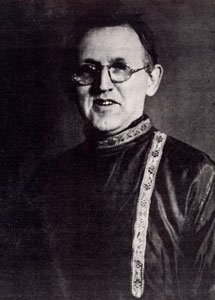
Latvian-American composer and choir director, the man behind the hymn 'My God and I' — three of his sides are restored on this hearth.
All rights reserved — © pelecalasitava.lv — 1936 photographRestored Recordings
Every track below is a remaster. Press play on the full sequence, or pick a single recording.
BARENITES SLAVINASANA
LATVJU TAUTAS DZIESMU VALSIS
LATVJU TAUTAS DZIESMU VIRKNE
LATVJU TAUTAS MARŠS
MY GOD AND I
PASTORAL PRAYER
PIE STABURAGA SAULE RIET
SOFTLY AND TENDERLY
THE SOLDIER'S REQUIEM
VECA KOKLE
About the restoration
Every recording here is a historical track sourced from a public archive and remastered through a purpose-built chain — the same fixed chain for every file, no machine-learning enhancement. The aim is simple: sound better, and meet YouTube's audio standards. Rights status differs per recording and sources are credited where known; anything still in copyright is published with attribution and removed on request. The surface noise of the original transfer is still audible, because removing it completely would mean removing the recording too. How the restoration works →